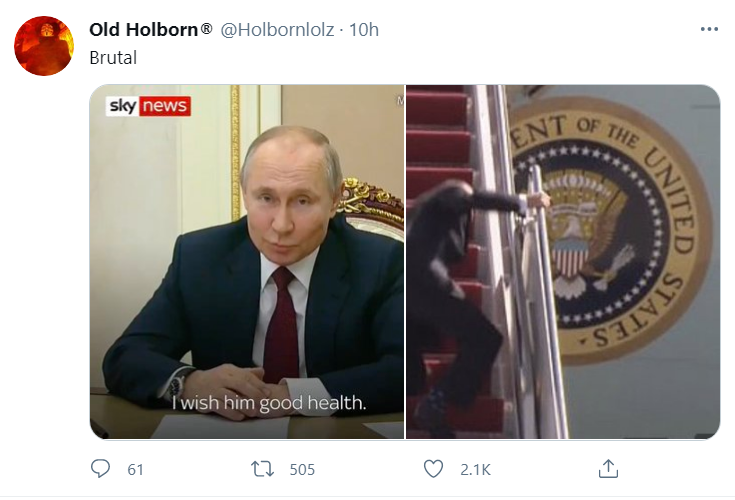
Vlad wishes “Good Health” to Joe.
Joe falls down … THREE times!
Jared Taylor, American Renaissance, March 19, 2021
Peter Cozzens, The Earth Is Weeping: The Epic Story of the Indian Wars for the American West, Alfred A. Knopf, 2016, 576 pp., $35.00.
The war in Afghanistan is said to be our longest war, but the war against the Plains Indians was longer, lasting from the 1860s until 1890. Peter Cozzens, a retired Foreign Service Officer and independent historian, has written what he hopes is a balanced account of a conflict that has, for decades, been defined by Dee Brown’s, Bury My Heart at Wounded Knee. Published in 1970, countless colleges have taught this biased book, and it has never gone out of print. Mr. Cozzens writes that it is unique for “so crucial a period of our history [to] remain largely defined by a work that made no attempt at historical balance.” The Earth Is Weeping is his carefully researched antidote.
It is a story of inevitable tragedy. I am reminded of the opening words of T. E. Lawrence’s Seven Pillars of Wisdom: “Some of the evil of my tale may have been inherent in our circumstances.” The Indians were an alien, warlike, and cruel people who stood in the way of Westward expansion, but as Mr. Cozzens shows, the American government never wanted to exterminate them. It tried to “civilize” Indians by making Christian farmers out of them, but nothing could have been more contrary to their nature.
There had been trouble with Indians ever since 1607. When Andrew Jackson sent the “Five Civilized Tribes” from the Eastern states out to the Great Plains, he believed it was a humanitarian solution and that whites would never follow them. However, as pioneers settled the West, they found tribes that were even more dangerous than the mostly farming, sedentary Indians in the East. There was never a chance for peaceful coexistence, only a choice between levels of horror.
In the West, Indians had traditionally lived for only two things: war and buffalo hunting. Until 1630, no Indians rode horses, so they hunted and made war on foot, and their most lethal weapon was the bow and arrow. By 1750, all plains Indians rode horses and had begun to use firearms; they became much more mobile and deadly.
New-World Spartans
Mr. Cozzens describes a way of life that could almost be that of Classical Sparta. He writes:
Fighting was a cultural imperative, and men owed their place in society to their prowess as warriors. . .. Fathers raised their sons to aspire to great martial deeds, and training for a warrior’s life began early . . .. At age five or six, boys were made to run long distances and to swim streams and were regularly deprived of food, water, and sleep — all with a view to toughening their bodies.
By the time an Indian was an adolescent, he was, in the words of Col. Richard I. Dodge, who spent 30 years fighting them, “the best rough rider and natural horseman in the world,” nothing less than “the finest soldiers in the world.” No young man could even think of courting a girl unless he had showed courage in battle. Any suitor had to face a mother who grilled him about his record as a warrior. If a young man wasn’t a “brave,” he was nothing.
Col. Richard I. Dodge, from his book, Our Wild Indians via Wikipedia.
Unlike the Spartans, who kept serf-like Helots to grow food, Indians hunted buffalo, which only made them better warriors. Women prepared meals, took care of children, and managed households. For many men, weapons and horses were their most prized possessions. They bought the best repeating rifles they could afford, but it was not easy to keep a good supply of ammunition, nor could they repair broken weapons. Corrupt cavalrymen sometimes sold them weapons, which Indians might use against them. Many continued to fight with bow and arrow — to excellent effect. One white trooper wrote that braves could hold half a dozen arrows in the left hand and let fly all of them before the first one hit the ground.
Taking scalps was proof of success in battle; an Indian scalp was worth more than a white scalp because Indians were harder to kill. It was common to mutilate enemy dead to keep their spirits from tormenting their killer in the afterlife. Indians were therefore determined to take their dead from the field. They practiced on horseback until they could scoop a fallen comrade off the ground at a full gallop. When the cavalry reported casualties for Indians, they were often just guesses because Indians left so few bodies behind.
Robert McGee, one of the few men ever to survive scalping. (Image via Library of Congress)
In battle, chiefs signaled to their men by holding a flag or gun tilted in a particular way or by flashing mirrors from high ground. Some blew shrill notes of an eagle-bone war whistle. Many Indians spoke English and when they were in earshot, they taunted and insulted the whites — just as they did enemy Indians.
Almost without exception, Indians believed in “medicine” to protect them in battle. This required ritual objects, incantations, face- and horse-painting, and prayers; some Indians would not fight if they could not prepare their “medicine.” Men wanted to ride with famous chiefs with strong “medicine,” but if such a man died in battle, his followers might give up the fight. Indians were afraid of artillery; just a few rounds would usually scatter them.
In most tribes, a warrior’s career was over by age 35 or 40, or once he had a son to take his place. It was a system of forced retirement that meant every man in the field was young and vigorous. Older men trained the young, and the most respected became chiefs.
Tribes moved with their families and possessions. Time and again, even lumbered with wives, children, and everything they owned, they outmaneuvered and outfought troops of professional soldiers — even in temperatures well below zero. Most of the time, the cavalry could not even find the enemy without the help of friendly Indian scouts.
The escape of the Nez Perce Indians to Canada in 1877 was a remarkable exploit. About 250 warriors, along with twice as many women and children under Chiefs Joseph, Looking Glass, and White Bird fought off and eluded a force of 1,500 Americans for 1,700 miles. They killed 180 and lost some 150. Mr. Cozzens writes that “man for man, they had proved themselves far superior to the soldiers sent out to stop them.”
Chief Looking Glass
Mr. Cozzens admires the Indians’ qualities, but also sees their weaknesses: “The Indians of the American West might have been among the best soldiers man for man in the world, but their tactics were developed over decades of inter-tribal warfare, and poorly suited to open combat against a disciplined regular army unit.” Surprisingly, many army units were terrible.
The boys in blue
The war against the Indians started as the Civil War ended, just as men were leaving the army:
Gone with the sober and purposeful volunteers who had restored the Union, in their place was a decidedly inferior brand of soldiers. . .. There were also a disproportionately large number of urban poor, criminals, drunkards, and perverts. Few soldiers were well educated, and many were illiterate.
The government was desperate to pay down the tremendous war debt and slashed the military budget. Soldiers were therefore badly trained, fed, and housed. General William T. Sherman, who fought Indians for years, wrote of army barracks in the West: “Surely, had the Southern planters put their Negros in such hovels, a sample would have been exhibited as illustrative of the cruelty and inhumanity of the man-masters.”
Mr. Cozzens writes — this seems difficult to believe — that “not until the early 1880s did the army encourage target practice, and replacements routinely took the field never having fired a rifle or ridden a horse.” One general remarked that while the army had a repeating rifle that was much better than Civil-War muzzle loaders, “I rather think we have a much less intelligent soldier to use it.” The cavalry had sabers, but almost never took them into battle. They knew they would be bristling with arrows before they got close enough to slash someone.
A 19th century Comanche warrior.
Mr. Cozzens calls the officers “a rogues gallery of bickering, backbiting mediocrities, drunks and martinets in epaulettes . . .. Both gambling and alcoholism were as prevalent among officers as they were among enlisted men. The sorry sight of inebriated officers stumbling to and from their quarters undoubtedly hurt unit morale.” Thousands of men deserted. Many saw a stint in the cavalry as a free trip out West that brought them within reach of the gold fields.
Such were the forces that faced each other as whites poured — in great numbers — into the West. In 1862, Congress passed the Homestead Act, which meant that any US citizen, including free blacks and female heads of household, got title to 160 acres of federal land West of the Mississippi if he improved the property and lived on it for five years.
Between 1861 and 1864, the population boom led to the creation of six new territories: Nevada, Idaho, Arizona, Montana, Dakota, and Colorado. In one six-week period, more than 6,000 wagons passed through Nebraska heading West. The Indians never imagined there were so many white people. During the winter of 1865 to 1866, whites so thoroughly depleted buffalo and antelope herds in Montana that the northern Oglala nearly starved to death.
In a period of just three years, railroads hauled 4,373,730 buffalo hides east from Kansas. Philip Sheridan, a Yankee who went on to fight Indians, knew how important buffalo were to the Indians and reveled in the slaughter. Hide hunters, he said, “had done more to settle the Indian problem in two years then the army had done in 30. For the sake of lasting peace, let them kill and skin until the buffalo are exterminated.” Without buffalo, the Indians could not live. They had no choice but to move onto a reservation and learn to farm or become wards of the Indian agency.
From Richard I. Dodge’s Hunting Grounds of the Great West
Sometimes, Indians had exclusive hunting rights and sometimes not, but either way, there were always hotheads who thought they could scare off the whites by killing enough of them. Buffalo hunters were mounted and well-armed, so Indians attacked settlers who may have never shot a buffalo — and did so with legendary cruelty. They slaughtered children, tortured men, ravaged and kidnapped women.
Mr. Cozzens writes of Kansas women captured by Indians: “They had been gang raped by the warriors, beaten without provocation by the Cheyenne women, and passed from hand to hand by purchase or as gambling winnings.” A typical game was for squaws to tie a white woman to a horse, turn them loose on the prairie, and let the men chase them on foot. Whoever caught the woman owned her.
Mr. Cozzens writes:
No Indians elicited less sympathy from frontier citizenry then did the Apache. Their incessant raiding kept Arizonans in a perpetual state of turmoil. The agony they inflicted on their captives, torturing them with exquisite cruelty, nauseated people in the territory and instilled in them a burning thirst for revenge on any and all Apaches.
Sometimes, young reservation Indians went marauding just for sport, slipping back onto the reservation — which was supposed to be inviolate to US soldiers — before the cavalry could catch them. Older Indians knew very well what these rampages would bring. In 1868, when the Cheyenne chief Black Kettle learned that his braves had slaughtered and raped settlers in the Saline River valley in Kansas, “he tore off his clothes and pulled out clumps of hair in grief.” He knew what was coming. He did his best to make peace, but was killed that same year, along with 200 other Cheyenne, two-thirds of them women and children.
Chief Black Kettle
The Dog Soldiers, a Cheyenne sub-tribe that hunted in parts of Nebraska, Kansas, and Colorado, played out the usual tragedy:
When the Union Pacific Railroad began its inexorable way through their country, bringing thousands of settlers and driving off the buffalo, the Dog Soldiers had thought to save their country and their way of life the only way they knew how — with horrific raids calculated to terrorize the whites into keeping away. Few whites understood the Dog Soldiers behavior, and fewer still could excuse the atrocities. The Dog Soldiers were likewise unable to comprehend the social and economic forces that impelled the whites to take their country.
Indians were just as merciless in battle. After a victory, women came for the whites, stripping and mutilating the dead and torturing the wounded. It was common to disembowel a living man, cut off his penis and shove it in his mouth, or cook him over a slow fire. The trooper’s motto was, “Save the last shot for yourself.”
There is no doubt that ill-disciplined white soldiers butchered Indian woman and children at such places as Sand Creek (1864) and Wounded Knee (1870), but they practiced nothing like the elaborate torture that was common among the Indians — but that was their way of making war before the white man came.
In any conflict, civilians die when armed men consider the entire population hostile. During the Vietnam War, some Americans’ view was, “If it’s dead and Vietnamese, it’s a Vietcong.”[i] A German POW, who was being surreptitiously recorded and had no reason to lie, told a fellow prisoner about how his men dealt with suspected partisans on the Eastern Front:
There were fifty men in the village; forty-nine of them were shot and the fiftieth was hounded through the neighborhood so that he should spread abroad what happens to the populations if a German soldier is attacked.[ii]
Notable men
The Earth Is Weeping recounts every major engagement between whites and Plains Indians. Only a specialist would know how they all ended, so there is plenty of suspense for general readers. Many fascinating characters emerge on both sides, and one of the most interesting is the Apache Geronimo. He was born in 1829 in what is now New Mexico, and was given the name Goyahkla, meaning “He Who Yawns.” He dropped this uninspiring name and kept the one Mexicans gave him — which is Jerome in Spanish.
Geronimo
Mexicans killed his family, and he took revenge many times over. He once said: “I have killed many Mexicans; I do not know how many. Some of them were not worth counting.” Geronimo was a gifted war leader, but too dour and disliked ever to become a chief. He claimed to have magical powers that would cause a rifle pointed at him to jam or misfire, and many Indians believed him.
On his forays north into the United States, “he pillaged ranches, swept up livestock, and killed randomly, torturing men in every imaginable way, roasting women alive, and tossing children into nests of needle-crowned cacti.” He surrendered several times, moving to the reservation, but broke out. Once, he bolted back to Mexico when new rules banned the traditional Apache practices of beating women, carving off noses of adulterous wives, and brewing corn liquor.
Mr. Cozzens writes that after Geronimo surrendered for the last time, he surprised everyone by “becoming a model farmer and impressing his growing circle of white friends as a ‘kind old man.’ He said he had learned much of the whites during his long years of captivity, finding them to be ‘a very kind and peaceful people.’ As he got older, he became a celebrity, appearing at fairs and expositions. He entered a calf-roping contest at age 75 and sold signed photographs of himself.
In 1905, Geronimo rode in President Theodore Roosevelt’s inaugural parade, and even dictated an autobiography. Four years later, age 79, he was riding home drunk and fell off his horse. A neighbor found him the next morning lying in freezing water; four days later he died of pneumonia.
Sitting Bull met a different end. He once said, “The white man never lived who loved an Indian, and no true Indian ever lived that did not hate the white man.” He was killed in 1890 in an unnecessary shoutout with native police who worked for the Indian Agency.
Sitting Bull (Credit Image: David F. Barry via Wikimedia)
George A. Custer stands out among the whites. He was last in the class of 1861 at West Point, where he committed infractions that should have gotten him expelled. The academy let him graduate because the Union needed officers to fight Confederates. After the war, he went West. The first time Custer saw a buffalo he tried to hunt it, but the buffalo gored his horse. Custer tried to shoot the buffalo but killed his horse instead. He didn’t know where he was and wandered for five miles before stumbling onto a troop of cavalry. It was another case of his legendary good luck. Louis Hamilton, the grandson of Alexander, rode next to Custer on an Indian campaign, and was killed by a single shot.
Custer had a reputation for recklessness. He was also an arbitrary commander, handing out harsh punishments for minor infractions. During his first Indian campaign, he heard rumors that his wife Libby might be having an affair. He abandoned his post to find her and got a one-year suspension from the army without pay.
Once, after Custer had attacked a peaceful Indian band, he falsely claimed he had recovered two kidnapped white children to make it seem as though he had been killing hostiles. After a battle with Cheyenne, Mr. Cozzens writes that the circumstantial evidence is strong that Custer and some of his men took young women as sex toys.
Mr. Cozzens writes that the Black Hills campaign that took Custer to the Battle of Little Bighorn was one of the most treacherous in the history of Indian warfare. President Grant wanted the Black Hills, even though they belonged to the Lakota by treaty.
General George Armstrong Custer (Credit Image: Mathew Brady via Wikimedia)
Custer’s relations with his two main subordinates, Frederick Benteen and Marcus Reno, were terrible. Benteen thought Custer had lost men in a previous campaign through laziness and bad judgment. Reno also hated Custer and went into the battle stumbling drunk. Against the heated advice of his white officers and Indian guides, Custer divided his command and attacked an Indian force many times larger than his. Little Bighorn was the army’s worst defeat in the West: The Seventh Cavalry lost 264 killed and 60 wounded. Indians lost 36 warriors, six women, and four children, with perhaps 100 wounded.
No sense of ‘Indianness’
Mr. Cozzens points out a fundamental Indian weakness in their fight against the whites: “Not only did the Indians fail to unite . . . they also continued to make war on one another. There was no sense of ‘Indianness’ until it was too late.” When the cavalry rode against one tribe, it was easy to find warriors from a rival tribe who wanted nothing more than to kill hereditary enemies. The army hired Indians as expert trackers and scouts, and “competent frontier officers knew they stood no chance of winning without them.”
Often, Indian allies did not join the attack for fear whites would mistake them for the enemy and shoot them, but once the action was over, they swooped in to scalp and kill the wounded and rape women.
Even if the red man had united against the whites, it would only have delayed the inevitable. United Indians might have been able to demand larger reservations with better farmland and game, but the free range could not last. Indians needed countless thousands of square miles to maintain their way of life, and whites were not going to cordon off half a continent for them.
Many Indians who moved to reservation and took up farming and herding as the government told them to do did well. However, can we imagine Spartans — trained for nothing but war — submitting to conquest and doing the jobs Helots did? For braves, war and hunting were the only ways to gain status. On a reservation, they were no better than women, and any who refused to work lived on rations from the Indian agencies. As Mr. Cozzens writes, “Idleness and brooding made abject alcoholics out of once-proud warriors.”
If ever there was a “clash of civilizations” — using the term loosely — this was one. But it would be wrong to see the war on the plains as a race war. It was a clash of incompatible ways of life. Racial animus added a vicious dimension, but once Indians stopped killing settlers, the army stopped killing Indians.
Indians lost the fight, but there had always been winners and losers. Tribes constantly fought each other, driving weaker bands from good hunting grounds and exterminating them when they could. Every square inch of land the Lakota defended against Custer was land they had stolen from other tribes.
To put it in contemporary terms, “diversity” and uncontrolled immigration destroyed the Indian way of life. There is poignancy in the last words of the Lakota war leader Crazy Horse, who had fought alongside Sitting Bull at the Little Bighorn. As he lay dying of a bayonet wound at the hands of a white trooper, he said, “All I wanted was to be left alone.”
[i] Sonke Neitzel and Haradl Welzer, (Jefferson Chase, trans.) Soldaten, Alfred A. Knopf, 2012, p. 88.
[ii] Ibid, p. 79.
https://www.amren.com/features/2021/03/american-settlers-meet-spartans/

Another example of DON’T TRUST THE SCIENCE.
One should ALWAYS be skeptical of experts.
VERY often they lie; especially when money is involved.
Just look at Doctor Fauxi; his companies profit from the, ahem, “advice” he gives.
Also, experts make mistakes.
Hell, I know. I’m a little expert myself.
From Vox Day:
Another old medical standby is vaporized by the evidence:
As the official old guy, you might be interested that what we were always taught to ice injuries and use the RICE protocol turns out to be as accurate advice as a low-fat high-grain diet or clear soda and crackers for a cold.
Just recently discovered this myself through this article.
The inventor of the RICE protocol has even admitted he was wrong. From the forward to Gary Reinl’s book, ICED! The Illusionary Treatment Option
Almost 40 years ago, I coined the term RICE (Rest. Ice. Compression. Elevation.) as the treatment for acute sports injures (The Sports medicine Book, 1978, page 94). Subsequent research shows that rest and ice can actually delay recovery. Mild movement helps tissue to heal faster, and the application of cold suppresses the immune responses that start and hasten recovery. Icing does help suppress pain, but athletes are usually far more interested in returning as quickly as possible to the playing field. So, today, RICE is not the preferred treatment for acute athletic injury.
– Dr. Gabe Mirkin, M.D.
Another example of something that makes perfect sense when you stop and think about it, but I never did because literally everyone my whole life told me use RICE for injuries. And of course, I advised others the same way.
I never iced anything but a badly sprained ankle, but mostly because I simply didn’t like icing. And I figured out very quickly on that the best way to avoid post-exercise stiffness was a) a hot shower, b) movement, and c) stretching. While we had ice baths on the university track team, I never once took one. I mean, why would you ever get in an ice bath when they’ve got perfectly good jacuzzis next door?
http://voxday.blogspot.com/2021/03/mailvox-ice-is-not-nice.html
PS I had “discovered” this little remedy, all by myself, through trial and error.
When you exercise a lot, you hurt yourself a lot.
I have a weak left ankle; from a stupid stunt during teenagehood.
It twists rather more easily than the right one.
Best remedy for a twisted ankle is to walk on it, gingerly at first, then slowly faster and get the blood flowing.
Otherwise, the blood stays there and dies and becomes blue and black.
New blood equals healing.
NO expert was needed in this discovery.
PPS Many years ago I read a lot of books on health and how to slow down the aging process.
One recommendation from many books, and thus written by medical “experts”, for the public, the “average Joe”, like myself, was/is to take an aspirin a day to prevent heart diseases.
ALSO, one should become one’s own medical adviser by age 40 (a piece of advice in one of those medical books).
(:-))
So, I adopted the Aspirin habit.
Two or three years ago I went to buy Aspiring at the pharmacy at COSTCO.
The aspirins were now BEHIND the counter.
Huh?
Aspirin!?
But, Tylenol was on the shelf.
Huh?
I asked for some aspirin at the counter..
The pharmacist asked me why I wanted aspirin; “Did I have some medical condition?”
“No, I just want it as preventative medicine against potential heart attacks:, I replied.
The pharmacists, in his white professional smock, lifted his HAUGHTY nose at me and replied that aspirin did not do any such thing.
“But, but but…”., I replied, “this is the accepted medical wisdom”.
He got REALLY annoyed by this.
“NO!” Medical SCIENCE was NOT recommending this.
I got insecure. I am no doctor and maybe, just maybe, I had misunderstood the medical advice I had read.
I went home and researched the topic on the internet.
And, OF COURSE, some medical doctors and experts DO recommend Aspirin as protection against heart disease.
Got home, cracked the books open, and Yes, of course, I HAD read that advice in some books.
I am still stung by the arrogance of the pharmaceutical expert.
PPS Of course it can be more serious than just arrogance.
The pharmaceutical expert family, the SACKLER killed many thousands of people, OVER-prescribing opioids.
The made billions over decades.
Nobody is going to jail.
They are just paying a fine.
Even the left-wing rag, THE GUARDIAN, is calling them EVIL!
Trust the Science!
Ha! Ha! Ha!
This hasn’t aged well – and in record time too!
Who’s laughing now, huh?
NOT THE DEAD GUY!
A Polish doctor who was filmed mocking COVID-19 vaccine skeptics as he was inoculated died 19 days after getting his shot.
Dr. Witold Rogiewicz of the OVI (VIP) Infertility Treatment Center in Warsaw received two shots: one on January 4, and the second on January 26. As he took the second inoculation, Rogiewicz made jokes at the expense of “anti-vaxxers,” COVID-19 and 5G skeptics, and people with autism. The video of his message has been published widely in Polish online media and on social media.
“Get vaccinated to protect yourself, your relatives, friends, and patients, too,” the gynecologist advised in Polish.
“Just to mention, I also have information for the anti-vaxxers and COVID skeptics; if you would like to get in contact with Bill Gates, you can do it through me. I can also lend you the 5G network in my body,” he continued, presumably referring to rumors that Gates funded projects to link vaccine records to a “tattoo” or microchip and those saying that China’s 5G network spreads the virus.
The doctor then took aim at Dr. Andrew Wakefield’s controversial theory that autism in children might be caused by the MMR (measles, mumps, and rubella vaccine). “Pardon me if I didn’t say something there for a moment, but I was just coming down with autism,” Rogiewicz said.
The doctor died of heart failure, just over two weeks later, on February 15. His fellow clinicians posted a notice saying that he had died, expressing their shock and sorrow and offering condolences to Rogiewicz’s family. The fertility clinic’s website also bears the lightning symbol of Poland’s pro-abortion movement in the top right-hand corner.
The story of the gynecologist who poked fun at those who oppose vaccines while being vaccinated, and died shortly thereafter, made the rounds of Polish social media. Critics of Poland’s COVID-19 vaccination program connected his death to his inoculation. However, Rogiewicz’s daughter denied that he had died from the vaccine.
“Over 2,000 comments about what happened appeared under the post about Dad’s death: that he mocked anti-vaxxer[s], and he himself died after being vaccinated,” Małgorzata Rogiewicz told Polish Newsweek magazine last month. “Dad had problems with his heart for many years, and he died suddenly of a cardiac arrest.”
“His death had nothing to do with getting the second dose of the vaccine,” she claimed.
https://www.youtube.com/watch?v=MuOvswxlYEc
Yes, I’m sure.
Pure coincidence.
The use of the Oxford/AstraZeneca vaccine has been suspended in three European countries, and suspect batches have been suspended in others after a number of deaths and dangerous blood clots occurred in relatively young people after receiving the vaccine. Both the British and European medicine regulators have told the public that there is no evidence that the deaths and blood clots were caused by the vaccine.
According to the Catholic Polonia Christiana magazine, the Polish government has no plans to suspend the use of the Oxford/AstraZeneca vaccine.
Maybe the Catholic Church should have done a better job promoting the fact that it is made from dead babies, huh?
They’re claiming that there is no fetal tissue in the vaccine itself, which might be true (probably is not), but they admit that the cell lines they’ve used to develop it are from dead babies.
It’s like selling cosmetics that are “not tested on animals” because the specific package you got wasn’t tested on animals.
Developing something using the corpses of dead babies should be considered extremely immoral by the Church, even if for some reason the Church is okay with altering people’s genetics (I don’t know why they would be okay with that, when they’re against tattoos, but okay).
By Meteorologist Stephanie Weaver
Published 2 days ago
Winter storm sweeps across US
Major winter weather hammered much of the United States this week, with many areas seeing rare snow and unusually low temps. (Source: FOX)
LOS ANGELES – Last month’s dangerous winter storms in the United States caused record subzero temperatures, power outages for millions of homeowners and led to more than two dozen deaths.
It also brought one of the coldest Februarys in decades.
During February, the average temperature was 30.6 degrees Farenheight — 3.2 degrees below the 20th-century average. This ranks as the 19th coldest February in the 127-year period on record and the coldest February since 1989, according to a new climate report by the National Oceanic and Atmospheric Administration (NOAA).
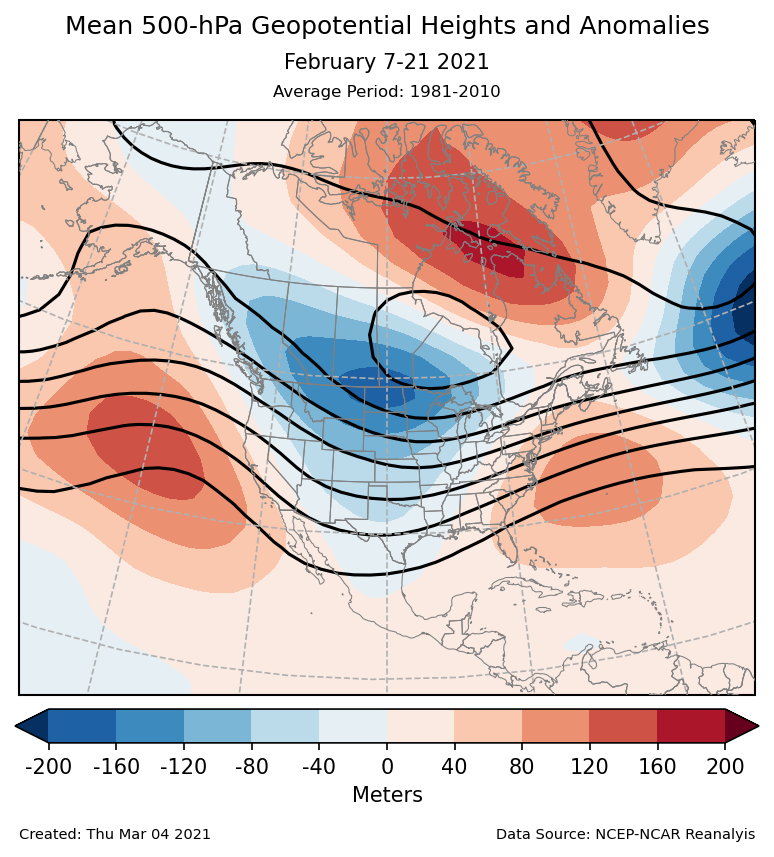
According to NOAA, the main driver for the weather across the U.S. during February was a strongly negative Arctic Oscillation (AO) during the first half of the month.
“This may have been the result of a sudden stratospheric warming event that occurred in January. The negative AO pattern favors a cold air outbreak over the central U.S., often referred to as a ‘polar vortex.’ A blocking pattern disrupted the jet stream, which prolonged the duration of this cold event,” NOAA wrote.
The video was recorded in Perth Amboy, New Jersey, on the evening of January 31 and into the early hours of February 1. Credit – buo01 on Twitter via Storyful
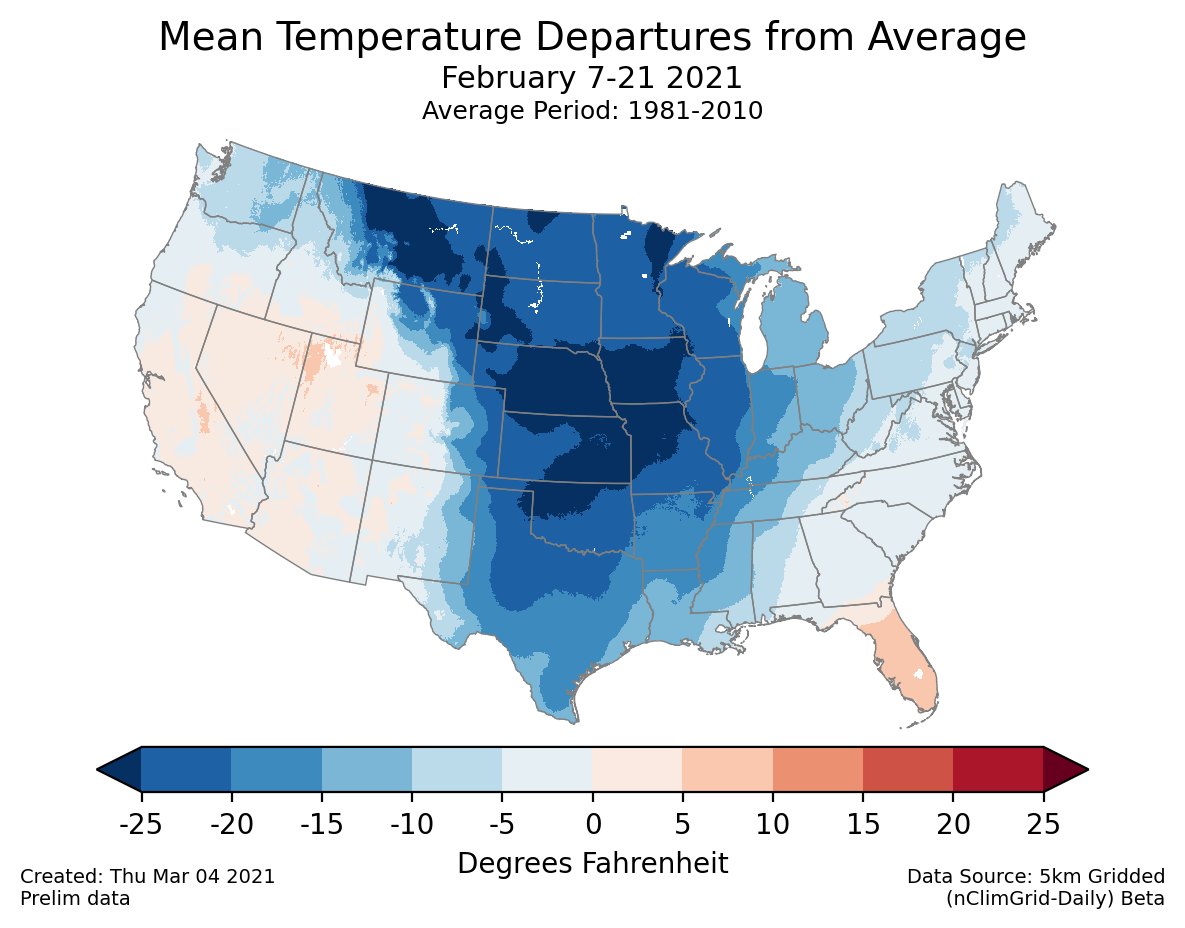
Below-average temperatures impacted a large portion of the country — from the Northwest to the Gulf of Mexico to the Great Lakes. In fact, six states — Nebraska, Iowa, Kansas, Missouri, Oklahoma and Arkansas — ranked among their 10 coldest Februaries on record, NOAA reported. Texas and Illinois ranked their 11th coldest.
“From February 7-21, large areas with temperatures more than 25°F below average were evident from parts of the northern Rockies and Plains to the central Plains. A station near Ely, Minnesota, bottomed out at −50°F on February 13 and 14,” NOAA wrote.
Based on preliminary data by NOAA, 62 all-time daily cold minimum temperature records were broken between Feb. 11-16 and 69 all-time daily cold maximum temperature records were broken between Feb. 15-16.
Several cities in Texas were impacted by February’s inclement weather.
According to NOAA, cities including Austin and Waco broke records for the longest freezing streak with temperatures below freezing between six to nine consecutive days from Feb. 10-19.
“Much of Texas endured the coldest air since December 23, 1989, during this period. Every county across Texas was under a Winter Storm Warning in mid-February. Wind chill values were below zero as far south as the Rio Grande River and into northeastern Mexico,” NOAA said.
A family took advantage of freezing conditions in Hurst, Texas, and built an outdoor ice rink on February 16.
Winter storms and a blast of frigid air from the Arctic left behind record-setting low temperatures and icy conditions across the Lone Star State.
Millions of Texans were also without power amid subfreezing temperatures.
Alaska also broke records, ranking among the coldest one-third of the 97-year period of record for the state.
In addition, Alaska had the coldest February on record in 22 years.
“The monthly high temperature for Anchorage reached a mere 30°F, making February 2021 the first month since December 1998 with all daily high temperatures remaining below freezing,” NOAA wrote.
RELATED: Severe winter storms will cause ‘widespread delays’ in COVID-19 vaccine shipments, CDC says
While the northern and eastern two-thirds of the state experienced below-average temperatures in February, the southwestern portion of the state, including the Aleutians, had temperatures near or above average for the month.
In fact, Alaska’s December – February average temperature was four degrees above the long-term average, ranking it among the warmest one-third on record.
Even as icy Arctic air dominated the nation, the overall winter (December – February) average temperature was 1.4 degrees above average, ranking it in the warmest third of the winter record.
In fact, above-average temperatures were observed across parts of the West, Southeast and New England.
According to NOAA, Maine ranked the third warmest and California ranked 12th warmest for the three-month period.
Meanwhile, the winter precipitation total was 6.10 inches, which was 0.69 inches below average, and ranked among the driest one-third of the 126-year period of record.
https://www.fox5ny.com/news/us-had-its-coldest-february-in-more-than-30-years-noaa-reports
If, at this point, you’re dumb enough to get the not-vaccine,you really don’t have any excuse:
Utah’s chief medical examiner urged the public not to jump to conclusions about the death of a 39-year-old woman four days after she received the second dose of Moderna’s COVID-19 vaccine — insisting there is no evidence the jab was connected to her passing.
After receiving her second jab on Feb. 1, Kassidi Kurill became sick and was hospitalized. Four days later, the single mom died under mysterious circumstances.
But Dr. Erik Christensen, chief medical examiner for Utah’s Health Department, told Fox News that the tragic mom’s second dose and her death are only “temporally related.” “We don’t have any evidence that there are connections between the vaccines and deaths at this point,” he insisted. “We don’t have any indication of that.”
That’s a fascinating excuse. Now we know JFK didn’t wasn’t assassinated. The rifle firing and his death were only “temporally related”. Also, when did New York newspapers start using British slang? Americans don’t get “jabs”, they get “shots”. Is “jab” supposed to be friendlier and less frightening, or more progressive, somehow?
Any time you see someone babbling about evidence, you can be certain they are lying. In this case, the dead body of the woman with the material that was injected would be the evidence, as well as the syringe that was used, the bottle from which the material was taken, and so forth. It’s certainly possible that she died of West African Rat Disease or asymptomatic Ebola or even an excess of ennui, but Ockham’s Razor strongly suggests that it was the not-vaccine that killed her due to the known exposure and temporal relationship.
I don’t what the long-term effects of the genetic markers being applied to a statistically significant percentage of the population will be, but I can certainly think of a lot of different uses for them. And pretty much none of them are good. If you wouldn’t have a glowing target tattooed on your forehead, you probably shouldn’t submit to genetic therapy by people who openly talk about their desire to reduce the human population.
http://voxday.blogspot.com/2021/03/dont-jump-to-logical-conclusions.html
March 11, 2021/1 Comment/in Conservatism, Featured Articles /by Hadding Scott
Like many of Rush Limbaugh’s listeners I felt a personal connection to him, but unlike many, I did not believe that he was practically infallible or always told the truth. I saw great merits in him but also weaknesses. “A Critical Look at Rush Limbaugh,” published by The Occidental Observer in late 2014, is largely a memoir of important occasions when Rush Limbaugh demonstrably had not been honest, and had served the political establishment rather than his own ideals or the people. We loved him, but he had let us down.
There were several purposes in writing this. Obviously, it was to educate the public, but this was not necessarily a disfavor to Rush Limbaugh. Suppose that he had made untrue statements only because he felt forced by circumstances: in that case it could be a relief for him, the alleviation of a moral burden, to find out that his audience “gets it.” On the other hand, while I was seeing positive changes in the Rush Limbaugh of 2014, the continuing pretense that he had practically never been wrong about anything was troubling, because it showed a lack of repentance. It was troubling, both that he was saying it and that the audience was accepting it. I wanted to call attention to Rush Limbaugh’s past failings so that returning to them would be difficult. I wanted to burn the bridges behind Rush Limbaugh so that he could not go back.
The critique seemed to attract wide attention. A few days after TOO published my two-part critique, Rush Limbaugh did something unusual. He spent his first hour ruminating over the “blogosphere” and “new media.” Based on the timing and some details in what he said, and the unusually subdued and thoughtful manner in which he spoke (not his usual boisterous persona), I believe that my criticisms were on his mind.
Significantly, he did not have any negative comment. On the contrary, he said that blogs and websites are part of the “alternative media” that he started with his syndicated radio show in 1988. About the creators of “new media,” he says:
Many of them are conservative, many of them are renegade conservative, but the point is, it is causing the Drive-By Media further panic, and the impact that all of this new media is having is clearly the erosion of the monopolistic mainstream media model. That deterioration is continuing. …
The American people — and I’m not being critical. You know me, the more the merrier, and the freer the speech, the better. I can deal with it. You know, I’m in a content content content business. I’m proud of my content, and I don’t make it up, and I don’t lie about it, so I got nothing to worry about. But the people in the Drive-Bys who have been living a lie for all these years are being exposed, and they are in a panic.
I had criticized him precisely for “living a lie.” He also referred to “being exposed,” and I certainly did expose him. He acknowledges that he could be a target of criticism from some “renegade conservatives” in the “new media” when he says: “I can deal with it. …. I got nothing to worry about.” His subdued tone suggested nonetheless that he had been affected by something.
Rush Limbaugh’s last years turned out to be his best. While he did not become 100% honest all the time, he did become more honest, and more valuable to his people. I was not alone in noticing this change; Don Black on Stormfront Radio also commented on it.
I certainly do not want to appear to claim credit for this, however. The important factor facilitating Rush Limbaugh’s evolution was not a screed that gave him pause on one day: rather, it was a change in practical circumstances, specifically the rise of Donald Trump.
Meghan Markle wrote to ITV’s boss to complain about Piers Morgan hours before the Good Morning Britain co-host quit on the day the show scored its highest ever ratings and beat BBC Breakfast, it was revealed today.
The Duchess of Sussex insists she was not upset that Mr Morgan said he ‘didn’t believe a word she said’ in her Oprah interview – but was worried about how his comments could affect people attempting to deal with their own mental health problems, an insider told the Press Association.
Standing firm today, Mr Morgan told reporters outside his West London home: ‘If I have to fall on my sword for expressing an honestly held opinion about Meghan Markle and that diatribe of bilge that she came out with in that interview, so be it.’
On Monday Ms Markle went directly to ITV’s CEO Dame Carolyn McCall, the former boss of the (far) left-wing Guardian newspaper, who signed off on the broadcaster’s £1million deal to show the Oprah interview and said yesterday they were ‘dealing with’ the GMB host.
Mr Morgan is understood to have been ordered to apologise – but he refused and quit instead saying he had the right to tell viewers his ‘honestly held opinions’ and declaring: ‘Freedom of speech is a hill I’m happy to die on’.
Good for him. The deceitful, grifting Hellmouth whore simply can’t bear to take any criticism whatsoever, and she has destroyed everything she touched with the exception ofSuits, in which she was a tertiary and mostly irrelevant character. If he holds his ground, Morgan will end up coming out of this kerfluffle on top.
It’s rather amusing how the British press is having such a hard time figuring out why she hates the British Royal Family so much.
Meghan hates Princess Kate for the same reason every moderately attractive girl with ambitions of being the popular hot girl hates the beautiful head cheerleader. It’s nothing more than raw, unmitigated envy. Meghan can’t compete with Kate’s position, class, style, or popularity, and her genetics prevent her from ever being considered “an English Rose”, so naturally she hates the other woman with the passion of ten thousand burning hells.
http://voxday.blogspot.com/2021/03/i-dont-believe-her-either.html
“Divorcity is our Strength”
Anytime I encounter determined use of the word "Diversity", I counter with the word "Divorce-ity".
WE do not need "diversity" in this country, WE need a national divorce from incompatible people.
If the marriage was ever good, I really cannot remember, but WE are well-into the angry language lessons already and inching toward domestic violence. WE badly need a divorce before one of us kills the other. Yeah, WE tried marriage counselors, on the Right and on the Left. Mostly, they were just egging on the fights. WE even tried arbitration, but the Supreme Court refused to hear any of it.
Even Wimmin can understand divorce-ity.
WE may need a required period of separation, WE divide up the property and the States and the Military and the kids, with the bills. But in the end, WE get a Final Decree of Divorce-ity. YOU go your way and I go mine. Go and Do whatever makes you happy. Sleep with the window open, for whomever you are expecting at night. Skip breakfast and finally lose weight. Learn a new hobby, like growing your own food. Take a trip on your own. But lose my number and don’t call me anymore.
Autism Candles by Nathan Young
GPB's Wordpress
GPB's Wordpress
News, Politics, and Continual Debate Over Who is the Greatest Leader of all Time, and Why is it President Donald J. Trump?
The latest news on WordPress.com and the WordPress community.
 Gerhard P. BISCHOF
You must be logged in to post a comment.