Uncategorized

What’s out? WhatsApp…


Here Are The ‘Alt Tech’ Platforms Trump Supporters Are Flocking To After Parler Executed By Amazon

BY TYLER DURDEN

THURSDAY, JAN 14, 2021 – 17:20

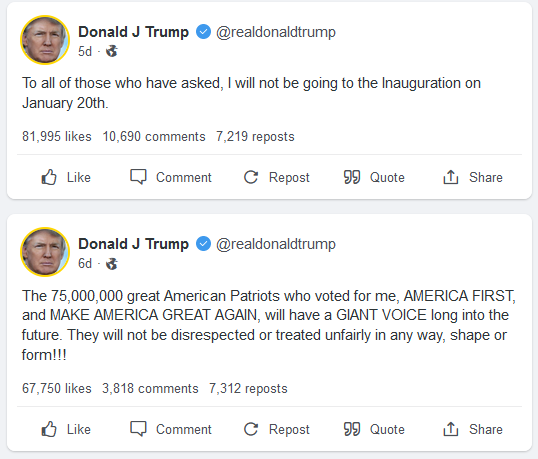
Over the past week, President Trump has been kicked off of Twitter, Facebook, Instagram, Snapchat, and was blocked from e-commerce platform Shopify – all because of a pair of relatively benign tweets on January 8th, two days after the Capitol ‘riot’ in which a small group of Trump supporters and a BLM activist were allowed into the Capitol Building through an opened door.

Trump’s ‘offending’ tweets:

Trump’s last two tweets which resulted in his permanent ban from the platform, via mirrored account at gab.com

Twitter, likely realizing the ‘last straw’ used to justify banning a sitting US president was extremely weak sauce (a move which has shocked the world), said the tweets "must be read in the context of broader events in the country."

Furious Trump supporters immediately began to abandon Twitter for so-called ‘alt-tech’ conservative-friendly alternatives, Parler and Gab.

Over the weekend, however, Amazon and Google banned Parler from their app stores, while Amazon Web Services dealt the death-blow by kicking them off their AWS cloud hosting service, rending the site ‘homeless’ and inaccessible until they find another host. Thanks to a flood of ‘cancel culture’ activists targeting all things Trump, Parler continues to be ‘dead’ for all intents and purposes.

Gab CEO Andrew Torba, meanwhile, backed up Trump’s entire Twitter account despite the fact that Trump hasn’t yet joined the network (thanks to Jared Kushner, apparently). Torba has been aggressively lobbying for the president to join. The network says it saw a 750% boost in traffic, adding 600,000 new users in a 24-hour period on Monday alone.

"The traffic just keeps growing. Hang tight, even more servers on the way today," Torba wrote on Saturday.

Where else are Trump supporters flocking?

With Parler currently unpersoned by big tech, and Gab’s servers running a little slow thanks to the influx of Twitter and Parler refugees, several other social media apps and platforms are seeing record traffic.

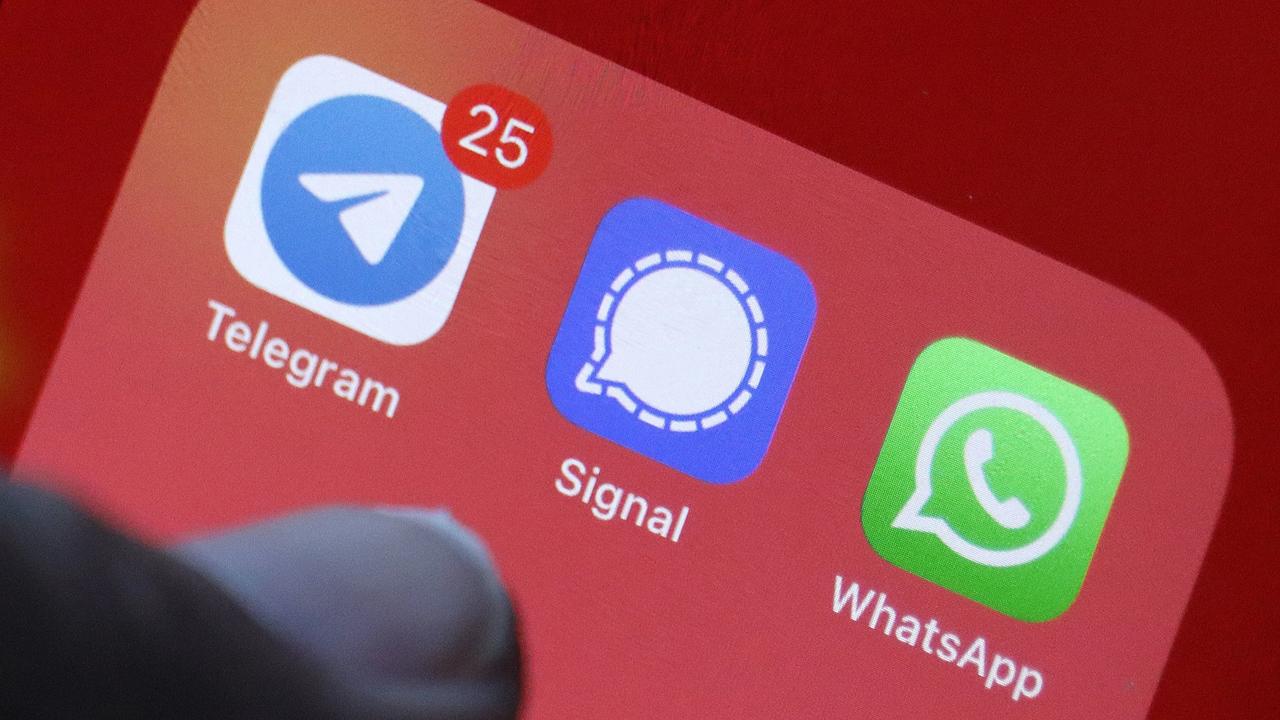
Telegram: Before Parler was taken to the woodshed by Amazon, influential users began calling on users to move to messaging app Telegram, where Donald Trump Jr. actively posts in a public channel. The service offers end-to-end encryption outside of Big Tech’s grasp, according to the Wall Street Journal.

One Telegram channel had over 16,000 "Parler refugees" as of Jan. 11, while the service announced on Tuesday that it had attracted 25 million new users globally in the preceding 72 hours, bringing its total active user base to 500 million.

The platform supports up to 200,000 members in a group, which is why it’s a favorite go-to for protesters in Hong Kong, Iran, and Belarus.

Signal:Widely regarded as the most ‘private’ app, Signal’s encryption is open source. It also offers encrypted calling and video chat. Between last Thursday and Sunday, the app saw around 7.5 million installations from the App Store and Google Play, around 43x more than it received the previous week, according to CNN.

The flood of new users has caused some glitches, however, with the company tweeting on Thursday that verification codes for new sign-ups may be delayed "because so many new people are trying to join Signal right now (we can barely register our excitement)."

"We are currently having a record level of downloads for the Signal app around the world," the company said in a Friday Reddit post.

Last week, Signal received some high-profile endorsements after Elon Musk, currently the richest man on the planet, tweeted "Use Signal." Twitter CEO Jack Dorsey retweeted it – later posting an image of Signal at the top of the App Store chart after it displaced Parler as the #1 download.

Edward Snowden also retweeted Musk, adding "That’s @signalapp, for those who don’t speak Elon."

Other platforms receiving attention of late include; video sharing sites Rumble and BitChute, livestreaming service DLive, along with CloutHub, MeWe and Minds.com.

What’s out? WhatsApp

After the Facebook-owned ‘secure’ messaging app announced a new privacy policy which states that the company may share user data with other Facebook companies "to help operate, provide, improve, understand, customize, support, and market our Services and their offerings," users began abandoning the app.

In Hong Kong, users have been leaving WhatsApp left and right, according to nikkei.com.

It is an indication that people in the city have joined social media users around the globe in a shift to other messaging platforms because of concerns over privacy, after WhatsApp dismayed many users by rewriting its terms of use on Jan. 6.

The new terms will essentially allow Facebook, WhatsApp’s owner, to gain access to certain personal information, such as contact lists, location, financial information, and usage data.

Since then, WhatsApp’s rivals have seen a record-breaking amount of downloads. –nikkei

One thing is for sure; with Trump kicked off Twitter, Parler currently dead, and ensuing refugees flocking to a bevy of alternative social media platforms that are siloed from each other, the conservative social media ecosystem has never been more fractured. Mission accomplished; we can only assume.

https://www.zerohedge.com/technology/here-are-alt-tech-platforms-trump-supporters-are-flocking-after-parler-executed-amazon

Here Are The ‘Alt Tech’ Platforms Trump Supporters Are Flocking To After Parler Executed By Amazon.docx

Uncategorized

How Everyday Americans Can Resist Big Tech.docx


How Everyday Americans Can Resist Big Tech

Americans should divest themselves from all products, services, and applications that give Big Tech power over our daily lives.

By Mitchell Gunter

January 13, 2021

You don’t have to be a conspiracy theorist to realize that Big Tech companies have been slowly tightening the digital noose around conservative and libertarian speech for years. Online radio host Alex Jones’ permanent suspension from Twitter on September 8, 2018 heralded to some on the Left a “new era of big tech responsibility,” as the Guardian phrased it. Others saw the move for what it really was—authoritarian censorship that ultimately has culminated in the suspension of the sitting president of the United States, Donald J. Trump, from Facebook and Twitter last week.

Far from remaining content merely to exclude opposing political forces from their own platforms, Big Tech is also rapidly moving to annihilate any competitors that would dare host conservative voices. Google and Apple have each banned the social media app Parler from their application stores, effectively barring 99 percent of smartphone users from easily utilizing the application on their devices.

Amazon Web Services, a global cloud-computing juggernaut that provides hosting services for Parler, went even further, announcing the termination of Parler’s hosting services on January 9, meaning the app, which is now offline as a result of this, will remain so without a new host.

If Big Tech can ban President Trump and stifle competition without a second thought, how can everyday Americans fight back? More importantly, why should the common citizen care?

We live in a world of digital totalitarians who impose online restrictions to quell dissent, punish adversaries, and ultimately consolidate power. In the United Kingdom, citizens are arrested for Facebook posts deemed offensive. In Russia, journalists who oppose the government are killed. In Iran, journalists who encourage protests are executed.

Under the Chinese Communist Party (CCP), Chinese citizens must contend with the “Great Firewall,” the most sophisticated censorship system in the world, which blocks thousands of websites such as Google, Facebook, Wikipedia, and Netflix over fears related to human rights, western democracy, and freedom of expression. Chinese citizens who access these websites do so under penalty of detention, interrogation, or even death.

Ironically, while Twitter has no issues silencing President Trump, the leaders of brutal regimes utilize the platform freely, such as Ayatollah Khamenei of Iran and state-affiliated Chinese media. Khamenei is free to tweet, “#Israel is a malignant cancerous tumor in the West Asian region that has to be removed and eradicated: it is possible, and it will happen,” and Twitter only recently cracked down on China’s boasting about its genocide against the Uyghur Muslims, stating that reeducation camps made Uyghur women “confident and independent,” rather than merely “baby-making machines.”

Of course, Big Tech has shown a willingness to directly collaborate with these nefarious actors in the past. In August 2018, Google reportedly planned a censored version of its search engine in China, dubbed “Project Dragonfly,” which would block searches related to free speech and human rights. The failed search engine would have linked searches to users’ phone numbers, allowing Chinese authorities to persecute political dissidents with ease.

In light of Big Tech’s actions over the past week, I suspect that efforts such as Project Dragonfly are no longer the outlier but are the blueprint for the internet’s future in the United States. Therefore, it is imperative that every American do his or her part to break Big Tech’s hold on our society at large.

Fighting back means embracing a small level of inconvenience in your life. Economist Milton Friedman once said, “There’s no such thing as a free lunch.” The principle holds true in our fight against Big Tech. Chances are that if a digital product, such as Google’s Gmail service, is free, then you are the product. Services like these sell your information or individual profiles of demographics and interests. More importantly, these services empower companies that are intent on regulating your speech, making them flush with capital and able to exert even more control over our national discourse.

Simply put, Americans should divest themselves from all products, services, and applications that give Big Tech power over our daily lives.

This does not mean we must become digital Luddites. In fact, many alternative applications and devices don’t require selling your soul, or your data, for the price of navigating today’s online world.

Delete all mainstream social media platforms from all of your devices, such as Twitter, Facebook, and Instagram in favor of alternative social media such as Parler and Gab, which are accessible via browser. Ditch Gmail in favor of more secure options such as ProtonMail, which is based in Switzerland with some of the best privacy laws in the world.

Forget censorious Reddit and head over to the vibrant, free-speech community, TheDonald.win, which blossomed from the pro-Trump subreddit r/The_Donald that was banned in June. Expel Google Chrome, which tech experts call “spy software,” from your devices in favor of privacy browsers such as DuckDuckGo or Brave.

Make a pledge to stay off YouTube as much as possible—instead of looking up that tutorial, ask your neighbor how to change a tire. In lieu of Google Maps or Waze, which are both owned by Google, use OpenStreetMap or, better yet, buy a physical, dedicated GPS device. Trash your physical devices like Amazon Alexa, Google Nest, and Ring Doorbell. Don’t let Alexa, which never stops listening to you, stay in your home one day longer. Replace Google Drive with low-cost cloud services like Linode or purchase a physical cloud server and hard drives of your own.

Cancel your Amazon Prime shipping and video services tonight and make a New Year’s resolution to buy local as much as possible. Download and backup your Google data, then delete it entirely. If you want the would-be authoritarians of Big Tech to pay, you must not contribute to feeding the behemoth.

Change is difficult and our digital lives are no exception to the rule. Don’t worry, if you make the leap of faith, the freedom you now enjoy will offset any burden imposed by online upheaval. Once you’ve emancipated yourself from the yoke of Big Tech, help your fellow Americans to do the same.

https://amgreatness.com/2021/01/13/how-everyday-americans-can-resist-big-tech/

How Everyday Americans Can Resist Big Tech.docx

Uncategorized

Opsec for Noobs


Opsec for Noobs

January 11, 2021Now that the digital Red Scare has begun, protecting your identity is crucial to ensure your life does not get destroyed. At the rate, the regime is moving, poor Opsec could lead to much worse things. This is the first of a series of posts about ways to protect yourself.

In this post I’ll go through some basic ways to protect yourself and to not be low hanging fruit. This will range from security basics like using a VPN and using encrypted chats to more advanced tactics like making sure your iPhone won’t turn into a listening device and getting your racist memes off of Apple’s servers.

Since this is intended for very noobie noobs, let me note the definition of OPSEC. Wikipedia defines it pretty well:

Operations security (OPSEC) is a process that identifies critical information to determine if friendly actions can be observed by enemy intelligence, determines if information obtained by adversaries could be interpreted to be useful to them, and then executes selected measures that eliminate or reduce adversary exploitation of friendly critical information.

A few things worth noting before I begin:

· I don’t work in cryptography or have a background in privacy. I’ve just been preparing for a digital Red Scare for 2+ years and am someone who is extremely protective of their privacy. I also use Apple products, so Android users will have to apply these principles to their devices.

· There is a Golden Rule that must be maintained: The Big Tech companies should not be trusted, and you should stay as far away from them as possible. Yes, Apple may have turned down NSA requests, but they also just banned Parler from the App Store. Yes, WhatsApp runs on Signal’s tech, but you also are not allowed to use the app without allowing them to share your location data with Facebook. Take everything they claim about protecting your privacy with extreme skepticism. They are being used by our enemies to disseminate their propaganda and don’t care about your privacy.

· The tactics I recommend range from common sense to extreme. Some require diligence and some require sacrifice of digital luxuries (i.e., No more ‘Sign in with Google’ everywhere). Some require your time and organization. Apply what makes the most sense to you and makes you rest easier at night.

· This post is divided between basic data security (using a safe browser, not letting your phone spy on you) and OPSEC (identity protection & not giving tech platforms any leverage against you). Some topics will overlap. I recommend incorporating the principles from both.

· I operate under one assumption which sounded extreme a week ago but now seems very realistic: Big Tech companies will eventually start doxing their customers. If you operate under their roof, then they know everything about you. They can very easily destroy you. Whether or not they act on this isn’t the point. The point is to create a forcefield around yourself to protect you from shitlibs who want you dead.

· This post is intended for shitpoasters who don’t want their lives destroyed by shitlibs. If you’re looking to do things on Tor that are illegal, etc. I can’t help you there. If the NSA or any of the Five Eyes want to see what you’re doing, they can and they will. These tactics are suggestions to protect yourself from being low hanging fruit for shitlibs looking to doxx and not giving your data to Big Tech platforms who can’t be trusted. The wind is blowing very fast in one direction.

·

Let’s get down to it.

OPSEC

Facebook

I’ll make this short and sweet. Delete Facebook. Now. If you insist on keeping it, carefully comb through your profile and comments and look for anything that might be deemed as offensive by the most ruthless of shitlibs and delete them. Platforms that require you to share your identity, like Facebook, have the highest amount of risk. Apply this principle to Instagram as well.

Twitter

Twitter requires you to share a phone number and email address with them. Under no circumstances should you give them your real phone number or an email address that can easily be traced to your identity (think yourrealname). You also shouldn’t give them an email address that you use for services that are tied to your identity, like Amazon or your doctor’s office. If you already gave them a real phone number or a standard email address, it’s very likely already stored in their change logs. An extreme and precautionary move would be to delete that account and create a new one.

Here are different ways to protect yourself on Twitter:

· Your Phone Number

o One option is to get a Google Voice number. Google Voice does require you to link it to a real number and yes, we are violating the Golden Rule, but it is a less risky option than handing over your real number as it’s one extra step they would need to take in order to find out who you are.

o Another more secure option is to get a burner phone and pay with cash. You can go to Target or CVS and get a Tracfone for less than $40. It comes with preinstalled apps like Facebook and others that you can’t delete, but the point is that the phone number cannot be linked to you. To be extremely careful, keep your real phone at home while you buy the phone to eliminate risk of location tracking.

· Email

o Don’t use Gmail, Yahoo, Outlook, or any of the big tech platform’s email services. More on that later. For now, create a ProtonMail account. It’s a fully encrypted email platform and their primary focus is user privacy.

o Create a ProtonMail email address that you will use on platforms that you don’t want traced back to you. Never use this email for services linked to your real identity. Ideally, you can create a different ProtonMail email for each sensitive platform, but that can be hard to keep up with.

o

· Sharing Information

·

o Post nothing about yourself that can be easily linked to you or where you are located. If you want to tell everyone you’re Norwegian, fine, there’s millions of Norwegians for them to sift through. If you post that you’re Norwegian and you’re in Chicago right now, that narrows it down a bit more but still pretty difficult. If you post that you went to a specific restaurant in Chicago on a specific day with your girlfriend, now that’s something they can work with. You get the point.

o

o Never overlap content. Don’t post the same thing in your Twitter account and your Facebook account. That’s how Orwell & Good got doxed. Also don’t say the same things word-for-word on Twitter that you say with your normie friends who don’t know about your account.

o

o This is obvious, and should have been said first, but don’t be a Facefag. If you Facefag and your life is ruined, you have no one to blame but yourself. To state the obvious again, never post a picture of yourself and never reveal your real name. And don’t post ½ selfies either….covering up half your face with an emoji over it. I’ve been seeing this a lot lately and it’s very gay. You’re gambling with your life. Don’t fuck around. If you want to post physique and completely cover your face, that’s a different story. Just make sure to cover up tattoos if you have them, but even revealing where you have tattoos is doxable info.

o

o Tell absolutely no one in your real life about your anon account. Doing so should have extremely strict requirements such as: you are 100% positive they are completely redpilled, they are not susceptible to leftist propaganda, they are a solid person and not the type to have a “moral revelation.” I also highly recommend you make sure they are woke to the WQ, the JQ and are willing to type the gamer word online, at a minimum.

o

One last note about Twitter. If you’re feeling nervous about how bad some of your old tweets may have been, you can use tweetdelete.net and nuke them. You can also nuke all of your likes (remember, people have lost their jobs over liking the wrong tweet). I recently did both after the most recent purge. You can also set tweetdelete.net to auto-delete tweets older than a week, a month, etc.

Moving on…

I have many racist memes on my phone. What do?

Adhering to the first principle, keeping your personal photos and / or racist memes on Apple and Google servers is a bad idea. A racist meme is just as risky as a racist text. If you have memes that can slightly be interpreted as racist (who would do such a thing?) and have them on Apple’s servers than yes, then you are dancing with the devil. Download your photos off their cloud and onto an external hard drive. Yes, Google Photos categorizes your photos oh so well. Don’t you just love scrolling back to that trip in Amsterdam when you banged your Airbnb hostess? Maybe you do, but who cares. People look back at old photos maybe twice a year anyway. It’s not worth your livelihood.

Again, I know it sounds crazy to think that Apple will dox their customers. But Twitter just banned Donald Trump. I repeat trusting the Big Tech companies is not wise.

After you put your photos onto a hard drive, put them on a very safe cloud server that prioritizes privacy. If you can build your own server, PrivacyTools.IO has some suggestions. If not, Proton has a cloud product in beta now and some email users have been given access.

Messaging Apps

To abide by the first principle, stop using iMessage and WhatsApp. Download Signal, Telegram or Keybase and start asking your friends to try them. All of them are focused on privacy and have features that cause your messages to self-destruct after a period of time that you decide. Signal is my preferred app of choice. Urbit is another more extreme option, but it requires a bit of technical knowledge.

Of course, you’re not going to convince all of your friends and family to jump onto these encrypted apps they never heard of. That being said, now is the best time to push for it, as Elon Musk has recently promoted Signal and it’s the #1 downloaded free app on the App Store as of today.

If and when you do have to use iMessage or WhatsApp, be very mindful of what you talk about there. If people bring up politics, don’t engage, just say “hey sorry, you gotta watch what you say these days, happy to talk on other apps that are more protective over privacy if you don’t mind”. Ideally you won’t type that and will say it in person, but it may not be an option and not replying can be awkward. This is ideal because in an extreme scenario, you can now be accused of having “something to hide.” Remember, our enemies don’t have to make sense.

Handling Multiple Platforms

Ideally, you will have a different username across all of your anonymous profiles. If they’re coming after User X, and User X is called “SaintFloyd” on Twitter, Gab and Parlor, now they can find all of their content in just a few clicks. If you have a big following it makes sense, why you would want to keep your brand and not start from scratch. This is a best practice.

BASIC DATA SECURITY

Remove Trackers From Your Phone

Chances are your iPhone is tracking every step you take, collecting your behavior and creating a profile about you and selling it. On top of that, you probably have multiple apps that are allowed to turn your camera or microphone on and record you. Let’s undo this immediately.

· Go to Settings –> Privacy –> Location Services –> make sure all apps are set to Never or Ask. I tend to not trust “While Using” because it’s unclear if the app can keep tracking you while you aren’t using the app but it’s still open in the background.

· Settings –> Privacy –> Tracking –> Toggle off “Allow Apps to Request to Track.”

· Settings –> Privacy –> Microphone –> remove access from all apps.

· Settings –> Privacy –> Camera –> remove access from all apps.

· Settings –> Privacy –> Motion & Fitness –> remove “Fitness & Tracking.” This feature literally tracks every step you take and when your body moves, as long as your phone is on you.

· Settings –> Privacy –> Analytics & Improvements –> remove “Share iPhone Analytics”, “Improve Siri & Dictation”, and “Share iCloud Analytics”.

· Settings –> Privacy –> Apple Advertising –> Untoggle “Personalized Ads.” If you want to get creeped out, click “View Ad Targeting Information”, and check out the profile they made about you.

· Settings –> “Siri & Search” and untoggle “Listen for “Hey Siri” and Press Slide Button for Siri. This gives Apple the ability to turn your phone into a microphone. More importantly, using Siri is extremely gay.

·

Protect Your Passwords

Download a secure and well-known password manager LastPass or One Password. You can install it as a browser extension, and it will automatically store all of your logins and passwords there. It can also import your saved passwords from your browser. Good password managers will tell you when you are using duplicate passwords on multiple sites, rank your privacy strength, and create very long complex passwords very easily.

Use A Safe Browser

If you are using Chrome: Wipe your history from it (cookies, logins, browser history), sign out, delete it from all of your devices and never download it again. The Golden Rule has been enforced. Moving on.

Firefox is historically known as very trustworthy, but they just released a blog post saying deplatforming people isn’t enough. Tremendous red flag. I stopped using them because of this.

Download Brave. Brave is designed around protecting privacy, has a pre-installed ad blocker, wipes your history after you close the app, and makes it easy to connect to Tor.

Use a VPN.

Using a VPN scrambles your IP address, plain and simple. Knowing your IP address makes it extremely easy to know where you are and then some. I prefer Proton VPN as I tend to trust Proton with all privacy related matters. They have a “Secure Core” option which guarantees you won’t connect to the internet without a VPN. So, if there is a connection issue with your VPN, you’ll lose Wi-Fi until it reconnects.

Encrypted Email Only

Applying the Golden Rule, get off of Gmail, Yahoo, Outlook, etc. and move to ProtonMail. Again, it isn’t as simple as having one ProtonMail address. Tutanota is another safe and encrypted platform as well. I recommend having one that you’re going to use for everyday things that are inevitably connected to your identity — your bank, Amazon, etc. You are now well aware your identity is connected to that email and it should therefore NOT be used on ANY platform where you are worried about what you’re posting. As mentioned in the Twitter portion of this post, create another ProtonMail address specifically for those platforms and ideally create one per platform. ProtonMail requires a backup email, so I recommend creating a Tutanota email first and using that as the backup. It doesn’t make sense to create a secure email and then using yourrealname as the backup.

Google yourself. What can your enemies learn?

It’s crucial to remove what is searchable about you publicly. Google your real name. See what comes up and go through it meticulously. You’re going to find yourself on those shitty scraping websites that also have your age and address. ALL of them have an option for you to request to remove yourself. Do it for every single one. Look up old usernames you’ve used on forums. Go back into them and delete your posts. Make your real name on Twitter private or just delete it. Use Google Images too. If you find your picture on sites, email the company, and demand they take it down. Ideally, you want to get to a place where you can search for yourself and then again with basic info (hometown, residence) about you and nothing appears.

That’s it for this post. On my next post I will go through more tactics like:

· Taking encrypted notes

· How to use burner credit cards

· What to do when you inevitably use Google apps like Maps & Translator

· Throwing Alexa & Google Home in the garbage (and then burning it)

· How to handle the most sensitive conversations in person

· Using 2FA (2 Factor Authentication) everywhere

· Getting your favorite books & podcasts onto an external hard drive before they become illegal.

I hope this was helpful. If you have questions, message me on Keybase @medgold or on Telegram @TuddyCicero

https://write.as/medgold/opsec-for-noobs

Uncategorized

Clever sillies – why high IQ people tend to be deficient in common sense.docx


Clever sillies: why high IQ people tend to be deficient in common sense

In previous editorials I have written about the absent-minded and socially inept ‘nutty professor’ stereotype in science, and the phenomenon of ‘psychological neoteny’ whereby intelligent modern people (including scientists) decline to grow-up and instead remain in a state of perpetual novelty-seeking adolescence. These can be seen as specific examples of the general phenomenon of ‘clever sillies’ whereby intelligent people with high levels of technical ability are seen (by the majority of the rest of the population) as having foolish ideas and behaviours outside the realm of their professional expertise. In short, it has often been observed that high IQ types are lacking in ‘common sense’–and especially when it comes to dealing with other human beings. General intelligence is not just a cognitive ability; it is also a cognitive disposition. So, the greater cognitive abilities of higher IQ tend also to be accompanied by a distinctive high IQ personality type including the trait of ‘Openness to experience’, ‘enlightened’ or progressive left-wing political values, and atheism. Drawing on the ideas of Kanazawa, my suggested explanation for this association between intelligence and personality is that an increasing relative level of IQ brings with it a tendency differentially to over-use general intelligence in problem-solving, and to over-ride those instinctive and spontaneous forms of evolved behaviour which could be termed common sense. Preferential use of abstract analysis is often useful when dealing with the many evolutionary novelties to be found in modernizing societies; but is not usually useful for dealing with social and psychological problems for which humans have evolved ‘domain-specific’ adaptive behaviours. And since evolved common sense usually produces the right answers in the social domain; this implies that, when it comes to solving social problems, the most intelligent people are more likely than those of average intelligence to have novel but silly ideas, and therefore to believe and behave maladaptively. I further suggest that this random silliness of the most intelligent people may be amplified to generate systematic wrongness when intellectuals are in addition ‘advertising’ their own high intelligence in the evolutionarily novel context of a modern IQ meritocracy. The cognitively-stratified context of communicating almost-exclusively with others of similar intelligence, generates opinions and behaviours among the highest IQ people which are not just lacking in common sense but perversely wrong. Hence the phenomenon of ‘political correctness’ (PC); whereby false and foolish ideas have come to dominate, and moralistically be enforced upon, the ruling elites of whole nations.

https://www.ncbi.nlm.nih.gov/pubmed/19733444

A better title would/should be:

SMART people (high IQ and education) are DUMB!

Clever sillies – why high IQ people tend to be deficient in common sense.docx

Uncategorized

Your chances of dying from Covid-19


Your chances of dying from Covid-19? If you’re healthy & under 65, a 40-mile daily commute by car is more likely to kill you

7 Oct, 2020 12:46

Get short URL

By Malcolm Kendrick, doctor and author who works as a GP in the National Health Service in England. His blog can be read here and his book, ‘Doctoring Data – How to Sort Out Medical Advice from Medical Nonsense,’ is available here.

Yes, coronavirus is a serious infection for the elderly and vulnerable. But, for just about everyone else, it’s a relatively mild condition with a very low fatality rate. The only thing to fear is our overreaction to it.

In this piece, I intend to establish a reasonably accurate estimate for the risk of dying of Covid-19 for the average healthy person under the age of sixty-five.

If we go back to the start of the pandemic, most of the world locked down based on a prediction that the Infection Fatality Rate (IFR) of Covid-19 would be in the region of one per cent.

In the UK, the pandemic modellers at Imperial College London, the group with the greatest influence on Government policy, estimated the IFR at 0.9 percent. In short, they predicted that approximately one in a hundred people infected with the Sars-Cov2 virus would die.

Has this estimate proven accurate? If so, within a world population of between seven and eight billion, we would expect to suffer up to 76 million deaths. So far, there have been just over one million.

Having said this, no-one predicted that everyone could become infected. The Imperial College model suggested that about 80 percent of people would need to be infected before we reached ‘herd immunity.’ I prefer to call it community-wide immunity. We are not cattle.

UK health secretary claims rise in Covid-19 cases is ‘very serious problem’

Which means that we were not going to reach that figure of 76 million. Under this 80 percent model, we might expect to reach 61 million deaths (7.5bn x 0.8 x 0.1). Even with this reduced number, we are a long way short. How long might it take to get to 61 million?

At present, worldwide deaths are running at around 5,000 per day. At this rate, it would take 33 years to reach sixty million deaths. I am not certain what the time limitation is before a pandemic could be considered to have ended. I would imagine that 33 years might be stretching things a little far.

Perhaps a more important point to consider is this. Do we know how many people have been infected up to this point? If so, we can make a better guess at the likely IFR, and your risk of dying.

Dr Mike Ryan, the executive director of the World Health Organization’s health emergencies programme, recently stated the WHO has estimated that 750 million people have been infected worldwide.

If this is the case, calculating the current, rather than the estimated, IFR is pretty straightforward.

You simply divide the one million deaths [1,034,068, to be fully accurate], by 750m.

1,034,068/750,000,000 = 0.138 percent.

ALSO ON RT.COM‘A terribly difficult and lonely death’: WHO laments 1 million Covid-related deaths worldwide but says virus can be suppressed

So, an IFR of 0.138 percent. Which is significantly lower than the initially predicted one per cent.

Or, to turn this figure around, according to the WHO figures, if you become infected with Covid-19, there is a one-in-750 chance you will die.

Of course, figures will vary from country to country. In Kenya, for example, the most recent attempt to estimate the IFR showed an exceptionally low rate. A study was done where antibodies for Sars-Cov2 were taken between April and June 2020. It was found that seroprevalence, the number of people showing antibodies, was 5.2 percent. (This will be an underestimate of true infection numbers, as many people do not create antibodies).

This represents an ‘infected’ population of just under three million (2,796,107), and there had been 71 deaths. Which provides an Infection Fatality Ratio of 0.00254 percent. This extremely low rate is, currently, unexplained.

On the other hand, the country with the highest overall death rate based on mortality per million is Peru. The total population of Peru is 32 million, and there have been just over 32,000 deaths. Which is a population fatality rate of almost exactly 0.1 percent. How many people have been infected in Peru in total? Uncertain. However, their IFR is going to end up in excess of 0.1 percent. Not everybody has yet been infected.

Covid-19 death toll tops 1 MILLION worldwide as pandemic spikes in US, Brazil & Europe

Why is there so much variation? This is currently unknown. Some people think that the indigenous population in Peru is at much higher risk than the surrounding ‘European’ population, due to genetic factors. However, let’s leave aside country-to-country and genetic variability for now. Overall, if you get infected, it looks as though the chance of dying currently stands at one in seventy hundred and fifty.

However, there is another enormously important factor at play here. Which is that, in almost all countries, Covid-19 is far more serious and deadly in the elderly population. Therefore, the average IFR doesn’t tell you much about your real risk. You need to factor in age.

For example, across most of Western Europe, if we look at excess mortality rates since the start of the epidemic, there have been just over two thousand more deaths than normal in those under the age of 45. These figures come from EuroMOMO, which gathers data from 24 European countries, with a combined population of 240 million (The UK is treated as four separate countries).

EuroMOMO describes its mission thus: ‘The overall objective of the original European Mortality Monitoring Project was to design a routine public health mortality monitoring system aimed at detecting and measuring, on a real-time basis, excess number of deaths related to influenza and other possible public health threats across participating European Countries.’

In those aged over 45, there have been more than 200,000 excess deaths. The figures from EuroMOMO in more detail are:

1-14 years = -15 deaths (minus 15)

15-44 years = 2,075

45 – 64 years = 17,826

65 – 74 years = 25,674

75 – 84 years = 65,982

85 + years = 98.069

So in all, for people aged 65-plus, there were 190,857 excess deaths.

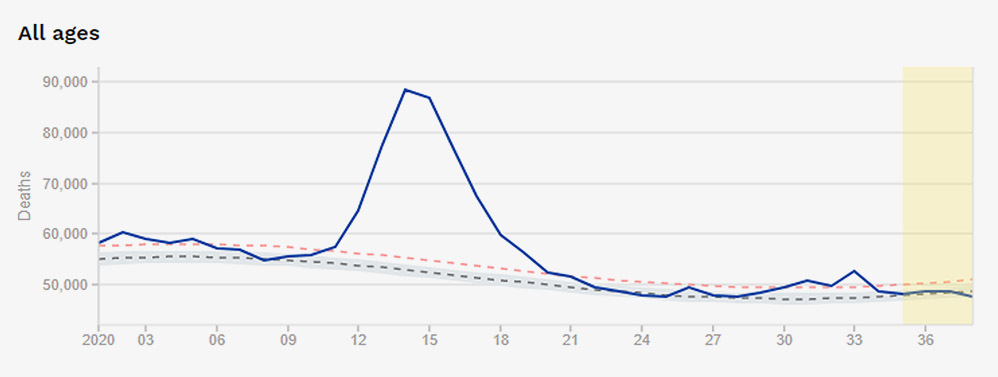
Below is the EuroMOMO graph of all deaths across Europe on a week-by-week basis in 2020. As you can see there is a big rise in excess deaths, that started in late March and was finished by the middle of May. There was a further small blip in early September, which has now gone.

© EuroMOMO

Essentially, if you are under 45 the risk of death (so far) has been 0.00158 percent or about one in 70,000. Over the age of 65 it is 0.17 percent.

What is it for those with no significant underlying medical conditions? Much lower.

Leaving that issue aside, for those in the lower age range, even in those up to 65, the risk of death remains extremely low. The following statement comes from a paper written by three Stanford University doctors, entitled ‘Population-level COVID-19 mortality risk for non-elderly individuals overall and for non-elderly individuals without underlying diseases in pandemic epicenters’:

“People <65 years old have very small risks of COVID-19 death even in pandemic epicenters and deaths for people <65 years without underlying predisposing conditions are remarkably uncommon.”

Death toll from Covid-19 could ‘very likely’ reach 2 MILLION before vaccine widely available, WHO says

As this paper went on to say, looking at Europe, and various US States:

“The COVID-19 mortality rate in people <65 years old during the period of fatalities from the epidemic was equivalent to the mortality rate from driving between 4 and 82 miles per day for 13 countries and 5 states.”

To put this another way, for healthy individuals under the age of 65, even during the peak weeks of the pandemic, a forty-mile commute was more likely to kill you than Covid-19 in most European countries and several US States.

Yes, for the elderly and vulnerable, Covid-19 is a serious infection, with an Infection Fatality Ratio significantly higher than most influenza epidemics. With the possible exceptions of 1957 and 1968, and leaving aside the flu pandemic of 1918-19 – which dwarfs everything else.

However, for the rest of the population, Covid-19 has proven to be a relatively mild condition with a very low fatality rate.

https://www.rt.com/op-ed/502802-chances-dying-covid-19/

Virus-free. www.avg.com
Uncategorized

When in doubt call it Covid.docx


‘When in doubt, call it Covid’: Trump accuses CDC of inflating figures as US passes 20 million coronavirus cases

3 Jan 2021 15:03 / Updated 1 day ago

Donald Trump has lashed out at the Centers for Disease Control and Prevention, claiming the health agency has exaggerated the pandemic in the US by using a broad definition of what constitutes a Covid-19 case or death.

“The number of cases and deaths of the China Virus is far exaggerated in the United States because of @CDCgov’s ridiculous method of determination compared to other countries, many of whom report, purposely, very inaccurately and low. ‘When in doubt, call it Covid.” Fake News!’” Trump tweeted on Sunday.

The outburst comes as the United States surpasses 20 million Covid-19 cases that have been linked to 350,000 deaths since the start of the health crisis.

ALSO, ON RT.COMLA hospital workers balk at taking Covid-19 vaccine, media says they’re somehow not ‘IN TUNE’ with science & Trump is to blame

The US president is not wrong in pointing out that other countries count coronavirus cases differently, however. Starting in April, the CDC began including “probable” cases and deaths in its tallies, although some states choose not to report such figures. A “probable” case or death means that health workers can label someone as Covid-19 positive even if they haven’t been tested, as long as the patient’s symptoms meet the “clinical criteria” of the virus.

Deborah Birx, a member of the White House Covid-19 taskforce who is stepping down from her post once Trump leaves office, acknowledged back in April that “in this country we’ve taken a very liberal approach to [Covid-19] mortality.” She noted that, unlike other nations, “if someone dies with Covid-19 we are counting that as a Covid-19 death,” even if it’s unclear whether the virus was the cause of the fatality.

This policy is wildly different from how China tabulates coronavirus cases, for example. China does not count asymptomatic carriers of the virus in its tally of confirmed cases, and as a result its official number of cases are far lower than what might be expected.

When in doubt call it Covid.docx

Uncategorized

Bill and Hill on Jeff’s Sex Slave Island


This shot really emphasizes Hilary’s lipedema/steatopygia

https://twitter.com/KirbySommers/status/1343432564288139266?ref_src=twsrc%5Etfw%7Ctwcamp%5Etweetembed%7Ctwterm%5E1343432564288139266%7Ctwgr%5E%7Ctwcon%5Es1_&ref_url=https%3A%2F%2Fwww.unz.com%2Fisteve%2Frest-in-peace-vagina-monologues-we-hardly-knew-ye%2F

Lipoedema is a long-term (chronic) condition typically involving an abnormal build-up of fat cells in the legs, thighs and buttocks.

Lipoedema – NHS (www.nhs.uk)

STEATOPYGIA

(Gr. arEap, fat, iruy17 rump), an unusual accumulation of fat in and around the buttocks. The deposit of fat is not confined to the gluteal regions, but extends to the outside and front of the thighs, forming a thick layer reaching sometimes to the knee. This curious development constitutes a racial characteristic of the Bushmen. It is specially a feature of the women, but it occurs in a less degree in the males. It is also common among the Hottentots, and has been noted among the pygmies of Central Africa. In women it is regarded among them as a beauty: it begins in infancy and is fully developed on the first pregnancy. It is often accompanied by the peculiar formation known as “the Hottentot-apron,” hypertrophy of the nymphae (Tablier). No satisfactory explanation of these malformations has been offered.

Steatopygia would seem to have been a characteristic of a race which once extended from the Gulf of Aden to the Cape of Good Hope, of which stock Bushmen and pygmies are remnants. The discovery in the caves of the south of France of figures in ivory presenting a remarkable development of the thighs, and even the peculiar prolongation of the nymphae, has been used to support the theory that a steatopygous race once existed in Europe.

What seems certain is that steatopygia in. both sexes was fairly widespread among the early races of man. While the Bushmen and Hottentots afford the most noticeable examples of its development, it is by no means rare in other parts of Africa, and occurs even more frequently among Bastaards of the male sex than among Hottentot women.

Steatopygia – 1911 Encyclopedia Britannica – Bible Encyclopedia (studylight.org)

Uncategorized

Vitamin D can help reduce coronavirus risk by 54% – Boston University doctor.docx


Vitamin D can help reduce coronavirus risk by 54%: Boston University doctor

The sunshine vitamin is easy to find and relatively cheap

SUDBURY, MA: September 16, 2020: Dr. Michael Holick holds Vitamin D Supplements in Sudbury, Massachusetts. (Staff photo by Nicolaus Czarnecki/MediaNews Group/Boston Herald)

By alexi.cohan | Boston Herald

PUBLISHED: September 17, 2020 at 2:00 p.m. | UPDATED: September 19, 2020 at 2:21 p.m.

Stop waiting for a miracle drug: A Boston University doctor says a sufficient amount of vitamin D can cut the risk of catching coronavirus by 54%.

“People have been looking for the magic drug or waiting for the vaccine and not looking for something this simple,” said Dr. Michael Holick, professor of medicine, physiology and biophysics at Boston University School of Medicine.

Holick and his colleagues studied blood samples from Quest Diagnostics of more than 190,000 Americans from all 50 states and found that those who had deficient levels of vitamin D had 54% higher COVID positivity compared to those with adequate levels of vitamin D in the blood.

The risk of getting coronavirus continued to decline as vitamin D levels increased, the study, published in the Public Library of Science One peer-reviewed journal shows.

“The higher your vitamin D status, lower was your risk,” Holick said.

Many people are vitamin D-deficient because there are only small amounts in food, Holick said. Most vitamin D comes from sun exposure and many are deprived, especially during winter months.

But the sunshine vitamin is easy to find and relatively cheap in drug stores, and taking vitamin D pills comes at no risk. “It’s perfectly safe,” Holick said.

“It’s considered to be, by many, the nutrient of the decade,” Holick said.

COVID-19 positivity is strongly associated with vitamin D levels in the blood, a relationship that stayed the same across different races, sexes and age ranges, the study states.

Vitamin D suppresses excessive cytokine release that can present as a cytokine storm, a common cause of COVID-related morbidity and mortality.

A deficiency in the nutrient alters the immune system, making one more likely to get upper respiratory infections, Holick said.

Throughout the pandemic, people of color have been disproportionately affected by coronavirus, experiencing a higher risk of acquiring it and having serious complications, according to the Centers for Disease Control.

RELATED ARTICLES

· Quincy restaurateur surprises staff with $35,000 in Christmas bonuses

· $600 stimulus check: When to expect a coronavirus relief payment

· Massachusetts nursing homes get their first shot at coronavirus vaccine: ‘One of the best days of my life’

· Massachusetts coronavirus cases up 4,060, hospitalizations rise as first vaccines given to nursing home residents

Holick’s study examined the ZIP codes of people of color and found patients from predominantly Black and Hispanic ZIP codes had lower levels of vitamin D and were also more likely to have coronavirus than in patients from predominantly white, non-Hispanic ZIP codes.

The average adult needs around 2,000 units of vitamin D a day, Holick said. He said he’s been taking 6,000 units a day for decades and is in great health.

Several other studies on vitamin D have shown its benefits to the immune system.

Research published with the National Institutes of Health showed people with lower vitamin D levels were more likely to self-report a recent upper respiratory tract infection than those with sufficient levels.

Another study of more than 11,000 participants published in the British Medical Journal found vitamin D supplementation reduced the risk of acute respiratory tract infection among all participants.

“Vitamin D definitely improves your overall immunity to fight infections,” Holick said.

https://www.bostonherald.com/2020/09/17/vitamin-d-can-help-reduce-coronavirus-risk-by-54-boston-university-doctor/

Uncategorized

The Top 10 Most-Suppressed News Stories Of 2020.docx


The Top 10 Most-Suppressed News Stories Of 2020

Authored by Frank Miele via RealClearPolitics.com,

Back in the day, when I was managing editor at the Daily Inter Lake in Kalispell, Mont., I enjoyed the end-of-year ritual of voting in the Associated Press’s poll of the Top 10 news stories.

When I started participating in the year 2000, my list would include many of the same stories that made the final AP list, although often with differences in ranking. But by the time I retired in 2018, my view of the news had sharply diverged from the AP’s consensus view. I’d become something of a gadfly by then, questioning what seemed to be an ever more transparent left-leaning bias in mainstream reporting.

That divergence was probably magnified by the 2016 candidacy of Donald Trump and the bright light he had shined on Fake News, but my disenchantment with my profession had been growing for years, as chronicled in my book “The Media Matrix: What If Everything You Know Is Fake?”

Still, there is no way that even as recently as four years ago I would have predicted just how abysmally irresponsible the media would become by 2020. Major newspapers are winning Pulitzer Prizes for blatantly false reporting on topics such as “Russian collusion.” Meanwhile, Silicon Valley oligarchs have appointed themselves censors — warning the American people not to read or watch anything that hasn’t been “fact-checked” by their hand-picked thought police.

The situation has gotten so bad that it’s no longer worth ranking the top news stories of the year because so little that is covered is news and so much that is news is written off as a “conspiracy theory.” That’s why I’m introducing Heartland Diary USA’s first annual presentation of “Last Chance to Wake Up and Smell the News They Tried to Kill.”

So here are five of the biggest suppressed stories of 2020. Pardon me if I don’t go into great detail on them, but the closer I get to the truth, the more likely that Google, Twitter and Facebook will bury my story, too.

5) Mysterious mutating lockdown:

Has anyone ever figured out why it is OK for grocery store workers to remain on the job during an international pandemic while serving the needs of the entire population with no restrictions other than wearing a mask, but it is considered dangerous for gyms to open or, most ludicrously, for anyone other than spouses of governors to take their boat for a quick spin around the lake? It seems like the lockdown can turn into whatever is convenient for politicians. The uneven effects of the lockdown on different states and different sectors have resulted in the shift of trillions of dollars of capital in ways that will reshape the economy for generations to come, yet we are not supposed to talk about it.

4) Hydroxychloroquine:

If you know anything about this drug, it is probably just that some guy in Arizona died after drinking it, and that maybe President Trump was somehow responsible. Well, as they say, a little knowledge is a dangerous thing. The guy in Arizona didn’t take hydroxychloroquine; he took a fish tank cleaner called chloroquine phosphate. And Trump never told anyone to take either the drug or the fish-tank cleaner. He just said hydroxychloroquine was a promising treatment against COVID-19. Of course, as soon as he said it, the radical academic leftists who control medical journals and associations warned that hydroxychloroquine had no benefit as a treatment and was potentially dangerous even though it had been safely used against malaria and various immune deficiency syndromes for decades. Fortunately, many doctors who were familiar with the drug continued to use it as a therapy in the early stages of COVID infections, and many patients around the world have been spared the most dire effects of the virus as a result. Just don’t expect to read about it in the New York Times.

3) Trump’s vaccine victory:

While the president has been painted as anti-science, it was his administration’s support that led to the fastest turnaround ever from viral discovery to viral vaccine — essentially less than a year. Even as House Democrats are poised to launch investigations into Trump’s supposed crimes against humanity for being president during the COVID crisis, lives are being saved as a result of his policies. Just don’t expect to read about it in the mainstream media, which spent much of 2020 ridiculing Trump for his prescient predictions that a vaccine would be developed by the end of the year.

2) Hunter Biden’s laptop:

The ability to bury the Hunter Biden story throughout the 2020 presidential campaign ranks as one of the greatest victories in the history of propaganda. Hunter is the son of former Vice President Joe Biden, and his acknowledged history as a drug addict is now considered his strong suit. The Senate Homeland Security Committee found extensive evidence that Hunter has made hundreds of millions of dollars for the Biden family by selling access to his father, so when Hunter’s laptop turned up with first-person incriminating evidence, it was pretty obvious that Joe Biden had a lot of answer for. Except that the media never made him answer for anything. It preferred to rest on the bizarre assertion from 50 former U.S. intelligence officials that clear evidence of foreign collusion on Hunter’s laptop had all the earmarks of a “Russian disinformation” campaign. This was errant nonsense. Reporters read the emails!

1) Election fraud:

It turned out that everything that happened in 2020 before Nov. 3 was just prologue for the greatest deception in American history — namely the hijacking of a presidential election through means both legal and illegal. Most importantly, every state that changed its election procedures without the consent of its legislature violated the U.S. Constitution. That’s why Republicans plan to challenge the Electoral College vote on Jan. 6. Whether you like Donald Trump or not should be irrelevant. You either follow the Constitution or you don’t. The fact that Trump increased his support in almost every demographic since 2016 and yet lost the election will apparently remain a mystery because the Democratic Party, with an assist from weak Republicans, is intent on continuing the charade that Joe Biden is a beloved elder statesman even more popular than Barack Obama.

I should add a disclaimer here. My list will not be your list. This is 2020, and there is plenty of suppression to go around.

You are hereby invited to submit your own contributions in the comments section below. In the meantime, rounding out my Top 10, here are some of the other major stories suppressed in 2020:

  • The communist links to antifa and Black Lives Matter;
  • how the Russian hoax was exposed but left unpunished;
  • how the policies of a certain governor in New York state led to thousands of COVID deaths in nursing homes;
  • the successful campaign of billionaire George Soros to subvert American jurisprudence by electing pro-criminal district attorneys;
  • and of course, the suppression of news itself.

Big Tech, take a bow!

https://www.zerohedge.com/political/top-10-most-suppressed-news-stories-2020

The Top 10 Most-Suppressed News Stories Of 2020.docx